Service — AI Agents
AI agents built to survive production
We're a senior product engineering studio that builds AI agents around a real workflow and a measurable outcome. Typed tools, permission boundaries, evaluation harnesses, and human-approval paths — so the agent still behaves on day 90, not just in the demo.
Agents tied to a workflow, not a demo
We start from a specific job an agent should own end to end — a form filled, a document generated, a browser task completed — and the metric that proves it worked. Applied AI earns its place only where it changes the economics of a workflow, so we scope for outcomes before we write a line of orchestration.
Tools and permissions as first-class architecture
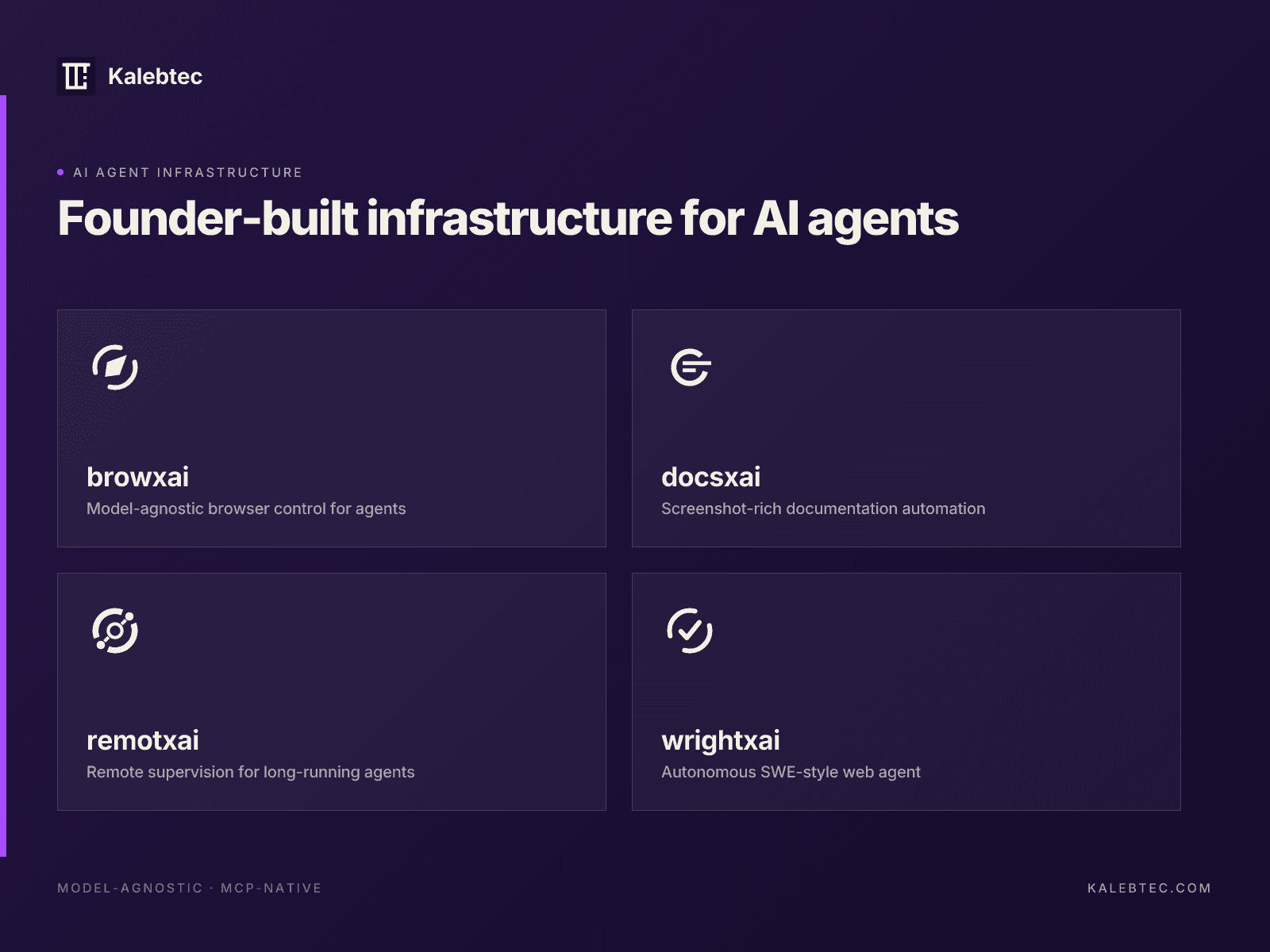
Every capability an agent reaches for is a typed tool with an explicit contract, running inside permission boundaries that decide what it can touch and where a human has to approve. We've built this into our own infrastructure — MCP-native, model-agnostic browser control and document automation — so the same discipline lands in your stack instead of a pile of brittle prompts.
Evaluation and reliability before scale
Before an agent goes wide, it runs against an evaluation harness with replayable runs, so a change that improves one case can't silently break ten others. We instrument for observability and cost from the first deploy, and we supervise long-running sessions so failures surface as signals you can act on, not surprises in a bill.
The product engineering around the agent
An agent is only as trustworthy as the UI, data model, and audit trail wrapping it — approval queues, run history, and clean operational handoffs to the humans in the loop. We build that surrounding product to the same senior standard as the agent itself, because that's what turns a clever prototype into a system a team relies on.
Frequently asked questions
What does it cost to build an AI agent with Kalebtec?
Cost tracks scope: a single well-bounded workflow agent is a focused engagement, while a fleet of agents with shared tooling and governance is larger. We start with a paid discovery to pin down the workflow, the evaluation criteria, and the integration surface before quoting build.
How do you keep an AI agent from doing something harmful in production?
We constrain agents with typed tools and permission boundaries, and route anything consequential through a human-approval path. Combined with replayable runs and observability, that means every action is scoped, auditable, and reversible rather than open-ended.
Can you work with our existing models and infrastructure?
Yes — our agent infrastructure is model-agnostic and MCP-native, so we integrate with the models, data, and tools you already run. We're a product engineering studio, so we build into your stack rather than locking you into ours.
Have a workflow an agent should own?
Bring the process and the metric — we'll scope the agent, the guardrails, and the evals. Book a strategy call.